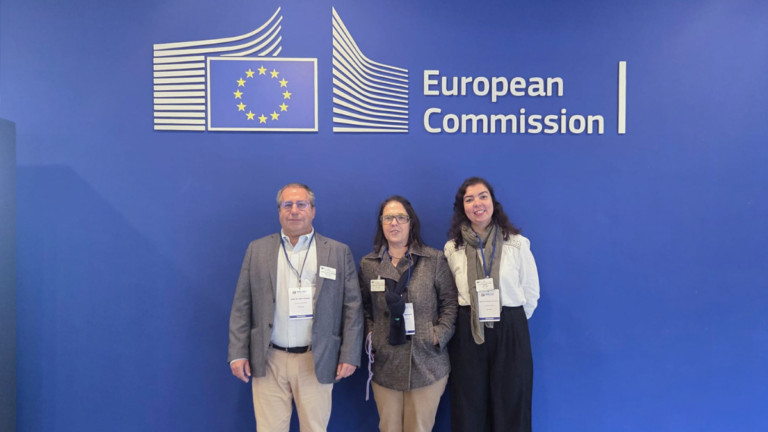
In the last quarter of 2025, FIRE-RES entered its final phase, focused on consolidating results, returning knowledge to the territories, and ensuring that the work carried out leaves a living and useful legacy.In Lousã, in collaboration with the School of Agriculture (ISA) and the Municipality of Lousã, we organised the 4th event of the Wildfire Innovation Community (CWI) of the Portuguese Living Lab (LL). This meeting brought together partners, technicians, decision-makers and the local community to present the main results of the Innovation Actions (IA) implemented in the territory and to reflect on the path taken since 2022. Through a participatory exercise, it was possible to identify clear progress, acknowledge persistent challenges, and gather direct feedback on the impact of FIRE-RES on the territory.On 4 and 5 November, the CoLAB ForestWISE team was present in Brussels at the FIRE-RES Final Conference, where the project’s main results, tools and continuity strategies were presented. The message focused on the impact of FIRE-RES, which depends on the ability to keep communities active within the Living Labs, to strengthen collaborative work, and to translate the project’s legacy into continuous on-the-ground action. Tiago Oliveira, from the Agency for Integrated Rural Fire Management (AGIF, I.P.), took part in the panel “Strategic Dialogue with the European Parliament” in his role as a decision-maker.During this period, strong investment in risk communication was also maintained. Within the framework of IA 4.2, and in collaboration with Euromontana, a Policy Brief was prepared for policy-makers and technical staff on the application of the mental models approach to the management of agricultural and forestry residues burning in Lousã. In parallel, Deliverable 4.3, led by CoLAB ForestWISE, was finalised, integrating contributions from INESC TEC, ISA, and the Sardinia and Aquitaine Living Labs, with a focus on participatory methodologies, mental models, and communication strategies adapted to different audiences.On 18 November, during a workshop organised by CoLAB ForestWISE within the framework of the WIC25 international conference, the FireEXplorer platform was launched. Developed by CEABN-ISA with our collaboration, the platform integrates several innovative modules, including descriptive narratives, strengthening the link between science, education, communication and social engagement.In the same context, the results of the Policy Clinics actions and the solutions co-created with stakeholders from Lousã and Gerês were returned to communities and decision-makers, reinforcing local ownership of the results.December was dedicated to the formal closure of the project and the consolidation of its legacy. Particular emphasis was given to the launch of the Art and Culture Toolkit – Art and Community Engagement as Restorative Practices, which gives voice to the Santa Comba Dão community in a post-fire recovery process, highlighting the role of culture, memory and artistic expression in territorial resilience. In parallel, the FIRE-RES Community dashboard was finalised and an exploratory version of the Fireline Estimation application was developed to support safety and decision-making by field teams during active fires.FIRE-RES thus leaves a legacy built on applied knowledge, tested methodologies, operational tools, active networks, and better-informed and more engaged communities — a solid foundation for future initiatives and for territories and communities that are more resilient to fire.Closing a CycleAfter four years, FIRE-RES comes to an end with a strong sense of mission accomplished. We can state that it was more than a project. It was synonymous with resilience in action, close dialogue, co-creation and continuous learning. It leaves behind active networks, strengthened capacities, tested methodologies and communities that are more informed, confident and engaged.To all partners, stakeholders, technicians, decision-makers and citizens who contributed to this journey, we extend our deepest thanks. The work carried out is the result of a collective effort and provides a solid basis for addressing future challenges, strengthening the resilience of territories and communities in the face of wildfire risk.